
Great Funk Players

I find that sometimes the most impressive players are not necessarily the flashiest, the fastest or write the heaviest riffs. As I get older and mature as a musician, I constantly find that I am enamoured with those players that just sit in the pocket as tight as possible, become one with the rhythm section and remove the work ‘shred’ from their dictionary.
As you can see by the title of this blog post, today I want to talk about some great funky players, those that have a straightforward sound, recognisable style and just bring the funk to everything they play. I will introduce the players briefly, give one example of a great song they have played on and try to expose you to some different guitarists that you probably do not have a picture of on your bedroom wall.
The Players
Cory Wong

Cory Wong is a modern guitar figure who occasionally performs with a variety of acts, most notably with his own group or with Vulfpeck. Born in 1985 makes him the youngest guitar player on this list, but that does not detract from his extensive recording and live performance experience.
Apart from his signature Fender Stratocaster, Wong is also known for using different plug-ins and Neural DSP hardware for his guitar tone. As is my understanding, he has a signature plug-in suite with Neural DSP called Archetype: Cory Wong that he uses live with the Quad Cortex from the same company. His plug-ins are one of the few that Neural DSP has made compatible with the hardware unit (not everyone is as lucky!).
In terms of playing, he was what I call an ‘elastic wrist’ – he moves smoothly and freely when blasting through 16th note sections yet he remains accurate and only plays exactly what is needed – he is also so deep in the pocket you will need some kind of Special Forces extraction team to get him out.
To achieve a note like Cory Wong, you will need a nice guitar with single coil pickups, like a standard Fender Stratocaster, a great clean amp and enough compression to help you keep everything in control. Too much compression and the guitar will lose most of the expression it gains through how dynamically you play.
Wong joined the band in the mid to late 2010s, but I believe this song was written and recorded specifically for his guest appearance prior to joining the band. The song has plenty of both the funky 16th note strumming and single note playing that he is known for – a must listen track if there ever was one!
Paul Jackson Jr.

Paul Jackson Jr. is a veteran of the session music scene in LA since the 1980s. He has worked with many huge names in the music industry, like Quincy Jones, Michael Jackson and Whitney Houston. More contemporary success would be something like Daft Punk/Nile Rodgers’ hit ‘Get Lucky.
Whilst the idea of the ‘session musician’ does not really exist for the most part any more, it once did and Jackson was one of the best. This meant having the skills to cover almost any project that he was asked to do, and the work was rolling in because he could pull it off. From jazz or blues lead work, to rock or disco numbers to funk as we are discussing today, he can do it all!
I personally am a fan of his super simple, super clean work on the song below and also ‘Get Lucky’; his parts elevate the song to another level.
This super group was initially made up of industry legends Chuck Loeb, Jeff Lorber and Everette Harp. Paul Jackson Jr. contributed some rhythm guitar parts to the tune above, ‘Gamblin’’ and after Loeb’s sad passing a number of years ago, Jackson joined the fold.
Ernie Isley
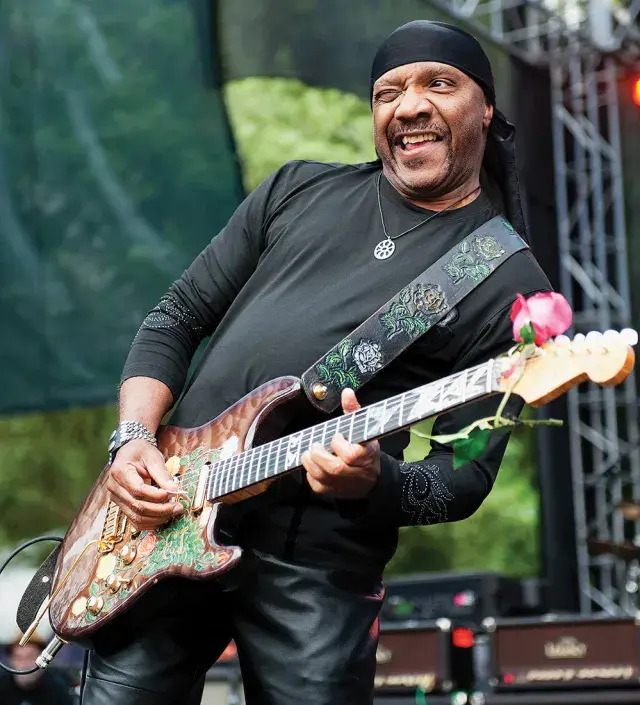
Ernie Isley was part of the famous group ‘The Isley Brothers’. This band were responsible for funk and soul classics such as ‘Summer Breeze’ (see below), ‘Footsteps in the Dark’ and ‘Coolin’ Me Out’. If you do not know these songs, then you will have surely heard them before somewhere.
Known for simple but effective lead work, it is Ernie Isley’s rhythm guitar work that is severely underrated. If you listen closely enough, you will notice how there are moments that the rhythm part supports another instrument (following the bassline, mirroring hits on the drums etc) and then runs through a brief strumming pattern. This way is more effective, at least to my ears, than something like Wild Cherry’s classic tune ‘Play That Funky Music’.
You simply cannot talk about The Isley Brother without mentioning this tune. As a child, I remember this song being used in TV advertisements, and I have also heard many bands attempt to cover it over the years.
The iconic, fuzz-laden guitar melody is a great contrast, the acoustic guitar slots into the song perfectly and everything mixes with the vocal harmonies and key changes like a dream. That recurring 8th/16th note melody that the song opens with, and repeats throughout the tune, is a great example of how powerful chords can be. The melody does not change, but it sounds a little different when played over each chord played by the piano.
Final Thoughts
What I think too many people miss when writing parts for songs is the impact that their part has on the overall song. When listening to lazily written tunes, or those written by inexperienced songwriters, the guitar part can just feel randomly placed and is not an integral part of the song. Just like a great bass line, a great rhythm part, especially within the funk genre, should not really stick out, however, the second it is removed that you notice that something is missing.
The main thing to remember is that you already have the skill to be able to create and perform amazing funk parts, and rhythm guitar parts beyond that. The key is learning how to apply it, so you could ask your teacher or spend some time studying some of your favourite rhythm guitar players and breaking down how they apply chords, textures and rhythms into what they produce. Another option is to see how many ways you can express Am over a number of bars, rather than how many different extensions you can play. Another fun challenge would be to see how consistent you can keep a simple funk riff over five minutes – if you rarely record to a click track, then do that and listen back to what you have… you might be surprised!


