
The Big Three: Scales, Chords, and Arpeggios for Guitarists
- The American Guitar Academy

- Feb 4
- 6 min read
When it comes to mastering the guitar, understanding the relationship between scales, chords, and arpeggios is a critical step. These three elements form the backbone of music, creating the framework for melody, harmony, and improvisation. Whether you’re strumming chords for your favorite song or crafting a solo, these fundamentals will improve your technique and deepen your understanding of how music works.
In this article, we’ll break down what scales, chords, and arpeggios are, explain why they’re essential to master, and provide beginner-friendly guidance for practicing them on the guitar. By the end, you’ll see how incorporating these elements into your practice routine can elevate your playing to the next level.
What Are Scales, Chords, and Arpeggios?

Scales
A scale is a sequence of notes arranged in ascending or descending order. It provides the foundation for melodies, solos, and improvisation. Scales follow specific patterns based on intervals (the distance between notes), giving each scale its unique sound. For instance, the major scale is bright and happy, while the minor scale has a more somber tone.
Common scales include:
The Major Scale: The most fundamental scale in Western music, often described as the “do-re-mi” scale.
The Minor Scale: A scale with a darker, more emotional character. There are many variations on the minor scale.
The Pentatonic Scale: A five-note scale that’s easy to learn and widely used in blues, rock, and pop music. There is a major and minor pentatonic scale.
Scales aren’t just for solos—they improve your fingering technique, help you navigate the fretboard, and deepen your understanding of musical keys.
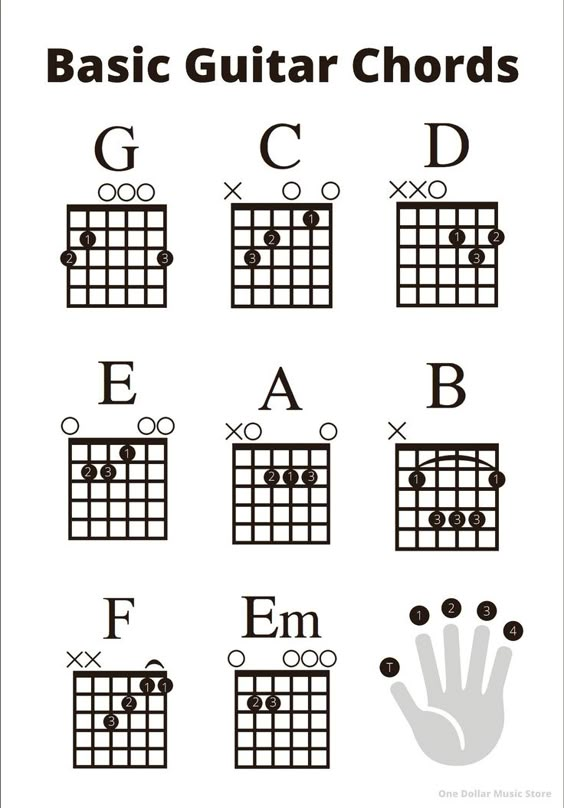
Chords
Chords are groups of notes played simultaneously to create harmony. They provide the foundation for most songs and are a key part of rhythm guitar. Chords are built from scales, often using the 1st, 3rd, and 5th notes of a scale to form what’s known as a triad, a 3 note chord. The most common triads are the major triad and the minor triad. Examples of common chords types include:
Major Triads: Bright and stable, used in happy or upbeat music.
Minor Triads: More introspective or emotional, adding depth to a song.
Dominant 7th Chords: Common in blues and jazz, adding tension and resolution. This chord features 4 notes instead of 3.
Learning chords allows you to accompany other musicians, write songs, and add depth to your playing. Chords are the common language between musicians, so learn them well!

Arpeggios
Arpeggios are essentially chords broken into individual notes played one at a time. Instead of strumming all the notes in a chord together, you pick them sequentially, creating a flowing, melodic sound. Arpeggios connect scales and chords, providing a linear way to practice harmony. For instance, incorporating arpeggios into a solo creates a more melodic and structured feel.
Arpeggios on the guitar are usually practiced in 2 different ways. Firstly, they are often played as a fingerstyle pattern with a chord shape held down and all the notes ringing together. This style of arpeggio is commonly used for rhythm guitar and accompaniment parts. Secondly, arpeggios can be played in high positions with each note played separately in a lead style. These types of arpeggios are more advanced and sound melodic. They are often used in solos and riffs.
Why Mastering These Fundamentals Matters
Building Musical Fluency
Scales, chords, and arpeggios are like a language—they’re the vocabulary that helps you express yourself musically. Understanding how they relate allows you to play confidently, whether you’re jamming with a band, improvising, or composing your own music. They also provide the framework for understanding music theory, giving you insight into how songs are structured and how different elements fit together.
Improving Technique
Practicing scales, chords, and arpeggios is an excellent way to develop finger strength, dexterity, and coordination. Running through scales helps you move smoothly across the fretboard, while practicing chord transitions builds hand strength and precision. Arpeggios, with their focus on accuracy and timing, refine your picking technique. These skills are essential for playing cleanly and confidently, no matter your style.
Unlocking Creative Potential
With scales, you can craft melodies or explore improvisation. With chords, you can write songs or accompany other musicians. With arpeggios, you can add texture and sophistication to your solos and rhythm parts. Together, these tools open the door to endless creative possibilities, making your playing more versatile and dynamic.
Applying These Concepts to Guitar
Scales on Guitar
Scales on the guitar are organized into patterns that span the strings. Instead of playing scales in a straight line, as on a piano, guitarists use patterns that repeat across the fretboard.
Beginner-friendly scales include:
The Pentatonic Scales: Often considered the easiest scale for beginners, the pentatonic scale uses only five notes, making it simple to memorize and versatile for solos. There are 5 pentatonic “boxes” or positions for playing the scale on the guitar. It is highly recommended to learn these early on, since they are fundamental to understanding the fretboard. They can later be expanded or altered into other scale patterns.
The Major Scale: There are many ways to play the major scale on the guitar. For beginners, I recommend learning these scales in the open position before learning movable scale patterns higher on the guitar. The major scale is the most fundamental in music because we use it to define the key of the song, derive chords, and build melodies. It will also teach you about sharp and flat notes and how they work within the scale.
Practicing scales helps you understand how music is organized and improves fretboard navigation. They also build important fundamentals such as fretting technique, picking technique, and timing. They also help you learn to identify which notes are in the key of the song you are playing.

Chords on Guitar
Begin with open chords, such as C, G, D, E, and A. These chords are easy to play and appear in countless songs. Once you’re comfortable, progress to power chords, which use the same repeating shape across the fretboard to play different chords. If these feel comfortable, you can expand them into the barre chord shapes.
Basic Types of Chords on the Guitar
Open Chords - These use open strings and are the most common.
Power Chords - These use only 2 notes and are movable around the neck.
Barre Chords - These are movable shapes where we press multiple strings with a single finger that makes “bar” across the strings.
Chords form the backbone of rhythm guitar playing, making them essential for accompanying songs and adding harmonic richness to your music. You can learn chords naturally by playing countless songs which feature them.

Arpeggios on Guitar
Arpeggios require breaking down chord shapes into individual notes. Start by playing the notes of an open chord one at a time, such as the C major chord. Pick the notes in sequence, either ascending (lowest note to highest) or descending. Now you are playing an arpeggio!
As you progress, practice arpeggios based on barre chord shapes and expand to more advanced patterns, such as 7th chord arpeggios. These exercises improve both your picking accuracy and your understanding of how chords and scales connect. When playing these shapes, you may need to add a few “missing” notes by playing two notes on the same string.

How to Incorporate These Fundamentals into Practice
Warm-Up Routine
Scales, chords, and arpeggios are perfect for warming up your fingers and mind. Begin your practice session with a few minutes of scales or arpeggios to loosen up your hands and improve your timing. To get the most out of your practice:
Focus on One Element: Spend time mastering one scale, chord, or arpeggio before moving on.
Use a Metronome: Practice at a slow, steady tempo and gradually increase your speed.
Combine Concepts: Play an arpeggio, then turn it into a chord progression. Learn which scale pattern fits over each chord shapes. These fundamentals are all connected.
Encouragement for Beginners
Mastering scales, chords, and arpeggios takes time and patience, but the rewards are worth it. These fundamentals are the foundation for everything you’ll play on the guitar, from simple melodies to complex solos. Even short, focused practice sessions can lead to significant improvements over time.
Set small, achievable goals, such as learning a single scale pattern or perfecting a basic chord progression. Celebrate your progress along the way, and remember that every great guitarist started where you are now.
Knowledge Builds
Scales, chords, and arpeggios are essential tools for any guitarist, offering the foundation for melody, harmony, and improvisation. By practicing these elements regularly, you’ll improve your technique, deepen your understanding of music, and unlock your creative potential.
You don’t need to dedicate the whole practice session to these. Start small, stay consistent, and let these fundamentals guide your growth as a guitarist. With dedication and practice, you’ll soon find yourself navigating the fretboard with confidence and creating music that speaks to you and your audience.


