
Using Multi-FX as Part of an Existing Rig

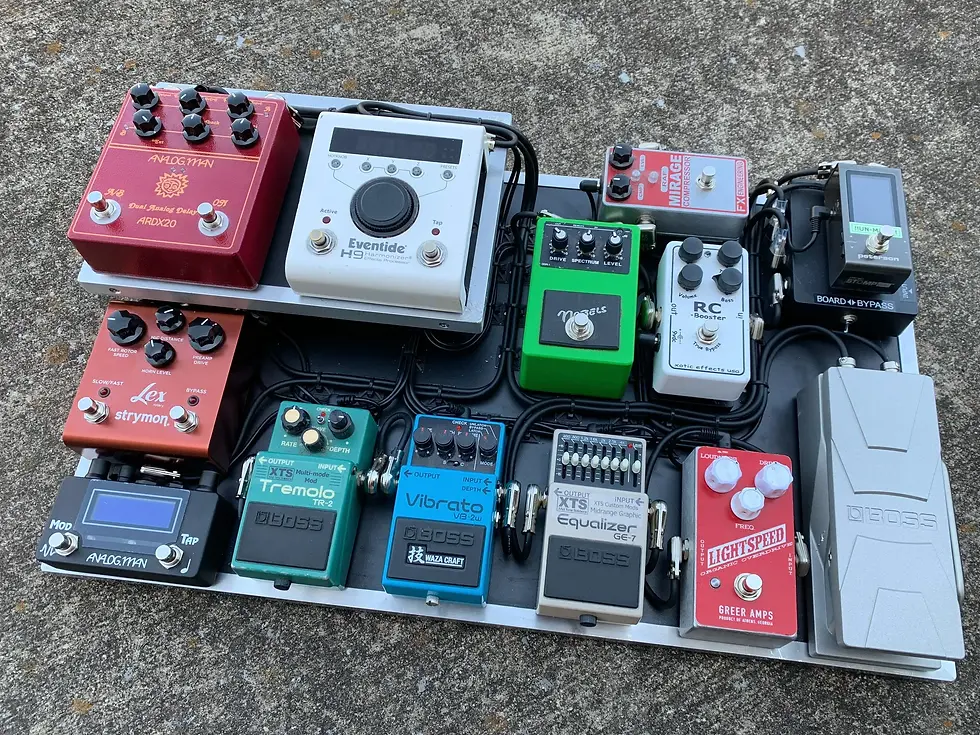
Some guitar players prefer to go down the multi-fx route for their entire chain; using products like the Helix from Line 6, the Kemper Profiler and a seemingly endless list of others to create your entire signal chain is commonplace. Whether or not you should do this is entirely your choice, and something I have discussed in a blog post before. The purpose of this blog post is to discuss uses for these systems within an existing guitar rig, whether you have a conventional amp set up or otherwise.

Not All Products Are the Same
Although I have had experience with running a hybrid system of the Line 6 HX Stomp and a guitar amp, I think it would be a good idea to make some classifications at this point. Some multi-FX do indeed have amp modelling or profiling, each with their subtle difference and avid supporters for each. Whilst you absolutely could use a Helix for effects only, the potential of the unit would be wasted (Line 6 also makes the HX Effects that is the same, but omits the amp modelling leaving you with a smaller product and lower price). Today I will focus on the units that supply effects only.
Some cheaper products, like the Joyo Vision R-09, have some great features and some great sounds. However, a few of the effects are really very poor in quality – this is ok for the most part, but if your goal is versatility then you should have high quality sounds at every step of the way.
Other products aim to replicate an entire effects chain, such as the Zoom MicroStomp family of products, but they can be hindered by excessive menu diving or limited functionality for live use. There are many great pedals, such as the Flamma Modulation FS05, but they only offer one effect at a time and can be limited to one type of effect (in this case, modulation) and may have fewer adjustable parameters than you need.
Why Would You Use One?
If you have a conventional pedalboard set-up and you are restricted by space, power supply options or budget, then a multi-fx pedal can be the answer to your troubles. Even having one expensive, multi-functional unit can be a wiser financial decision than by separate pedals.
My personal reason for using one within my rig is to allow cover the infrequent use of a small number of effects within a set. With my current band, I will use a phaser sound twice and a tremolo once throughout the whole repertoire, up to now at least. I cannot see a reason why I would complicate things by buying dedicated units for such a small reason. On the other hand, I use two drive pedals currently – a Providence Heat Blaster HBL-3 and an Xotic Effects AC Booster V2. I want, as well as frequently use, the sounds I can create when I use those pedals individually or in combination with each other – this is a better choice than going for something like the Boss OD-200 which has many different types of overdrive and distortion.
The end result of this discussion is that a good multi-fx choice can allow you to fill several small gaps, rather than fix glaring omissions in your tonal arsenal.
Does Newer Mean Better?
Every year there are new products being released, and some of them are aimed at fixing a problem that did not really exist in the first place. One of my recent discoveries has been the older M series of products (early 2010s) from Line 6; the M5, M9 and M13. The M13 is designed as an entire pedalboard replacement, the M9 is a little more applicable to my personal situation but it uses a dedicated power supply. The Line 6 M5, however, is small enough to easily fit on a pedalboard and it can be powered the same as any other effects pedal. These units are still commonplace with big names in the industry like Dan Huff and Tom Bukovac.
To go even older, I am friends with many great musicians that still use the Boss GT8, or even the GT6 for their effects – even Nuno Bettencourt uses the GT8 for his delays and solo boosts.
That does not mean that all modern solutions are not very good, but because there are so many it takes a lot more to narrow down what works best for you. Some more modern suggestions of multi-fx that I would be happy to recommend are Line 6 HX Effects, Zoom MS70CDR (if you are only using it in the studio), the Strymon Mobius (as long as you only want great modulation effects and nothing else!) and the Eventide H90 (if you have big bucks to spend!).
My Amp Has Effects. Should I Just Use Them?
Some famous amps have legendary reverb or tremolo circuits. Others have even had specific parts of their circuitry redesigned into a pedal format for a boost, overdrive or distortion circuit. However, the amps that have any extra effects like chorus, phaser or others tend to be aimed towards beginners. The sounds are usually, not always, below the quality a working musician or discerning guitarist would need. The biggest caveat is that they almost always are severely hindered by their controls; amps like the MGFX from Marshall have just a single knob to switch between and control many different effects.
Final Thoughts
Occasionally, someone that is creating a song will use a particular effect as inspiration and the creation stems from that. The opposite is also true, in that an existing part could then be changed by an effect. As a songwriter yourself, or someone covering a song, you must ask yourself if that effect is truly necessary. Does it need to be a spring reverb, or can you suitably produce the song with your normal reverb sound anyway?
One example I can give here is when I played the song ‘I See Red’ by Everybody Loves an Outlaw. The introduction has a very strong tremolo effect and, when I played this in a rehearsal without that effect, the song just did not feel right, it lost something special. Conversely, when listening to the song ‘Barracuda’ by legendary rock band Heart, you can hear a very subtle phaser-type sound on the main riff. Whilst it sure is cool to have on when you play it live; I do not feel the song is diminished in any way without it – this is just the same as the point I made earlier, in that a multi-fx really shows its strength here.
Have a chat with your friends, colleagues or guitar teacher and get their perspective on this subject.


